
Are mobile homes assembled on site? A complete guide to transport, positioning and installation
- Redazione
- 02/09/2026
Lorem ipsum dolor sit amet
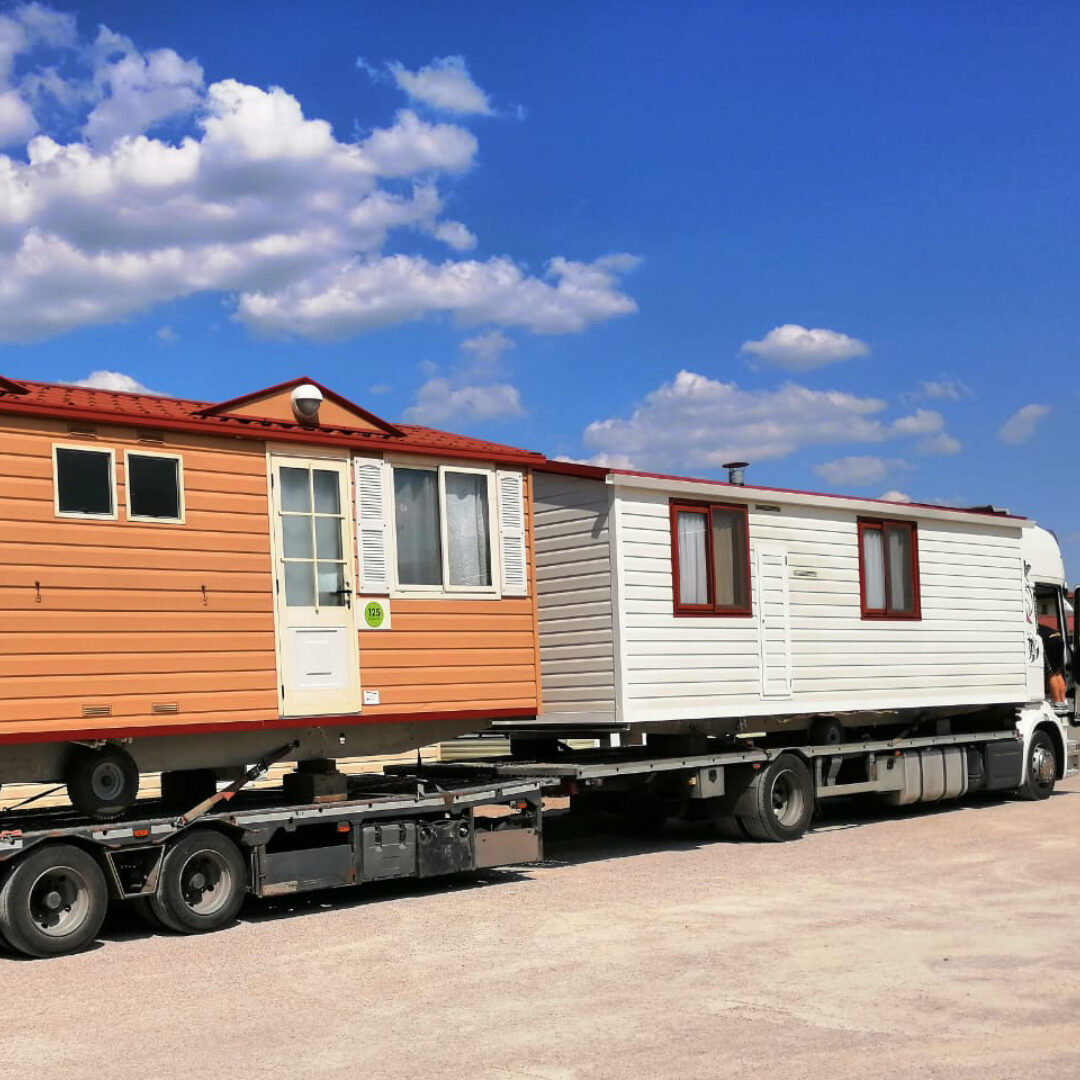
When buying a mobile home, one of the most common questions concerns what happens when it is delivered: does the mobile home arrive ready to use, or is it assembled directly on the plot?
The answer depends on the type of mobile home. Some models can be transported as a single, fully assembled unit, while others are made up of two modules that are transported separately and joined together on site.
Certain configurations may also require additional assembly or finishing work at the final destination.
Understanding how the process works is important not only to know how much work is required after purchase, but also to assess site accessibility, transport costs, the need for specialist equipment, utility connections and installation times.
In this guide, 4Springs explains step by step what happens to a mobile home from the moment it leaves the manufacturer to its final positioning at the destination.
In most cases, no: a mobile home is not built entirely on site in the same way as a traditional house.
Production takes place mainly at the manufacturer’s facility, where the structure, walls, flooring, roof, windows and doors, utilities, furnishings and other features included in the model are manufactured and assembled.
This allows most of the work to be carried out in a controlled environment and means that the structure can be delivered largely completed.
However, the amount of assembly required upon delivery depends on the configuration of the mobile home.
The main options are:
Therefore, referring simply to the “assembly” of a mobile home can be misleading. In most cases, the process involves transport, positioning, joining the modules where necessary, and completing utility connections.
Before reaching its final destination, a mobile home undergoes a series of manufacturing and assembly processes, depending on the model and manufacturer.
A fully equipped mobile home may leave the factory with:
This is one of the main differences between a mobile home and a traditional building constructed directly on a plot: a substantial part of the manufacturing process has already been completed before the mobile home is transported.
Naturally, the exact specifications vary from one model to another and, particularly when buying a used mobile home, it is essential to check the features and condition of the individual unit.
With a single-module mobile home, the entire home forms one structural unit.
For this reason, it is normally transported already assembled and equipped with its main features.
Once it reaches its destination, the work therefore does not involve “building” the mobile home, but mainly:
This generally makes the installation process relatively quick compared with traditional construction.
However, this does not mean that the mobile home can simply be unloaded and left on the ground. Its positioning must be carefully planned according to the characteristics of the mobile home, access to the site and the conditions of the final destination.
4Springs, for example, provides mobile home transport and positioning services, using suitable equipment according to the requirements of each project.
The situation is different when it comes to a double-module mobile home.
In this case, the home is designed as a single living solution but is divided into two sections to make <atitle=”Mobile home transportation” href=”https://www.casemobilioccasione.com/en/transport/”>transportation and handling easier.
The two modules are transported separately and, once they reach their destination, they are positioned next to each other and joined together to create the complete home.
This means that the customer does not receive two separate “houses” that need to be built.
Instead, they receive two completed modules that need to be correctly positioned and connected according to the manufacturer’s specifications.
Generally speaking, the process involves several stages:
The two sections are transported to the intended destination.
The modules are moved into place, taking into account alignment, dimensions and the required positioning.
The two sections are carefully moved towards each other until they reach the configuration specified by the manufacturer.
The modules are joined using the methods and components specified by the manufacturer.
The connection area is completed with the appropriate elements to ensure continuity and a proper finish.
Depending on the configuration, electrical, plumbing and other utility connections may need to be completed.
Once the installation is complete, positioning, connections and the operation of the main features are checked.
The exact procedure can vary considerably depending on the manufacturer and model. For this reason, it is important to follow the technical specifications provided for the specific mobile home.
Dividing a mobile home into two modules is not simply a construction choice.
It is primarily a logistical solution.
A fully assembled mobile home can be quite large. Transporting it in its final configuration can make it significantly more difficult to reach certain destinations.
By dividing the home into two sections, the dimensions of each individual load can be reduced, making transportation and handling easier.
This type of configuration can be particularly useful when a larger internal living space is required but access to the final destination makes it difficult to transport a structure of the same width as a fully assembled unit.
Yes, but it is important to distinguish between a modular mobile home and a structure that is actually built on site.
Not all prefabricated systems use the same manufacturing and delivery method.
Some manufacturers deliver fully finished modules that only need to be connected. Others may provide systems that are opened or partially completed at the destination. There are also prefabricated systems that are delivered as individual components and require more extensive assembly directly on the plot.
For this reason, before purchasing a mobile home, it is always advisable to ask the seller:
Another common misunderstanding concerns the meaning of “delivery”.
Transporting a mobile home does not necessarily mean installing it.
Transport refers to moving the mobile home from the factory or its original location to the final destination.
Positioning, on the other hand, refers to the operations required to move the mobile home into its final position on the site.
This distinction is particularly important when the destination has:
Depending on the circumstances, specialist trucks, cranes, forklifts, winches or other handling equipment may be required.
This is why the logistics of the site should always be assessed before transport is arranged.
Once the mobile home has been placed in position, the work may not necessarily be finished.
Depending on the model and the destination, additional operations may include:
Utility connections
The mobile home’s utility systems may be designed to connect to the services available at the destination.
The exact connection method depends on both the mobile home and the characteristics of the site.
Joining the modules
For double-module mobile homes, the connection between the two sections must be completed.
Installing the veranda
If the veranda is not already integrated or installed, it may need to be assembled separately.
Adjustments and checks
The mobile home should be inspected after positioning, particularly in terms of stability, alignment and the correct operation of its features.
Additional accessories
Depending on the project, further external elements or accessories may also be installed.
For this reason, it is more accurate to refer to the delivery and installation process rather than simply talking about “assembling” a mobile home.
There is no universal answer.
The time required depends on several factors, including:
A fully assembled single-module mobile home will generally require fewer on-site operations than a double-module solution.
A configuration made up of several sections, on the other hand, may require more time for positioning, joining and connecting the modules.
For this reason, it is not particularly useful to provide a standard number of hours or days without knowing the specific model and the characteristics of the destination site.
Yes, and this is an aspect that is often underestimated.
A mobile home is designed to be transported and positioned, but this does not mean that it can simply be placed anywhere without prior preparation.
Before transport, the destination should be assessed to ensure that suitable conditions are available for positioning the mobile home.
In particular, it is important to consider:
A preliminary site inspection and logistics assessment can therefore be just as important as the transport itself.
If you are considering purchasing a mobile home, these are some of the most important questions to ask the seller:
Getting clear answers to these questions can help avoid one of the most common surprises when purchasing a mobile home: assuming that the price includes every operation required to transport and position the unit at its final destination.
The most accurate answer is: it depends on the model.
A single-module mobile home is generally delivered already assembled and mainly requires transportation, positioning and completion of the necessary utility connections.
A double-module mobile home, on the other hand, is transported as two completed sections that must be positioned, joined and connected on site to create the finished home.
There are also different types of prefabricated systems with their own delivery methods, where certain components may need to be opened, assembled or completed at the final destination.
In any case, it is important not to confuse assembly with construction. In most mobile homes, the majority of the manufacturing process takes place before delivery, while the on-site work is mainly concerned with correctly positioning, connecting and completing the structure so that it is ready for use.
For anyone purchasing a mobile home, understanding these differences makes it easier to assess costs, timescales, site accessibility and the services required in advance.
Every mobile home has its own characteristics, and the destination site can have a significant impact on the complexity of transport and positioning.
4Springs provides mobile home transport, positioning and related services, handling both single-unit and modular configurations.
If you are considering buying a mobile home, it is therefore worth looking beyond size, price and interior layout and also considering how that specific unit will need to be transported and positioned at its final destination.

© Copyright 4 Springs Case Mobili s.r.l. 2024
